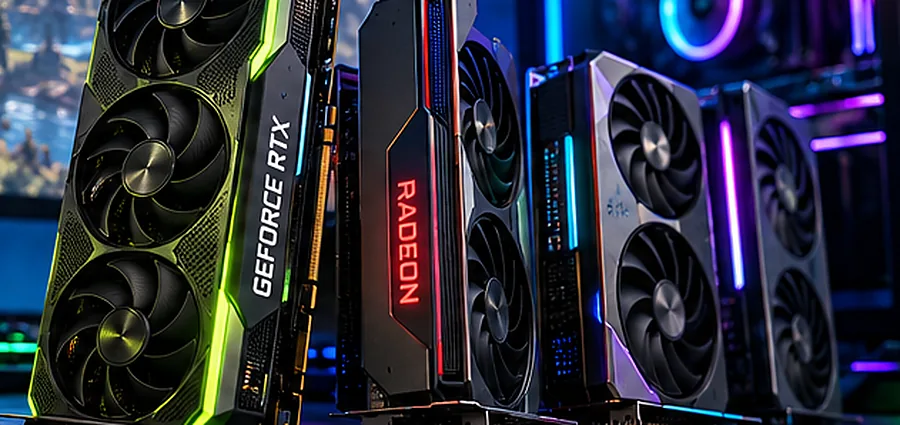
The 2026 GPU market is not the MSRP market
The October 2026 GPU market is still unusually expensive in some segments. Tom’s Hardware’s October median street-price roundup puts the Radeon RX 9060 XT 16GB around $464, RX 9070 around $634, RTX 5070 around $659, RX 9070 XT around $759, and RTX 5070 Ti around $1,099. These are dated reference points, not current listings or price promises. Always inspect the final retailer price, exact model, shipping and return policies.
1080p: spend as little as meets your game target
For a 1080p 60–75Hz screen, you often do not need a premium graphics card. The RTX 5060 and RX 9060 XT 8GB are capable entry choices for many titles, but demanding texture settings can punish an 8GB card. A budget-minded gamer should also evaluate whether their existing RTX 3060, RTX 4060 or RX 6600 already does enough. Spend money on a better monitor or SSD if a new GPU would produce frames your display cannot show.
1440p: our value-oriented sweet spot
For demanding 1440p gaming, the RX 9060 XT 16GB is worth considering as an entry point, but the RX 9070, RX 9070 GRE and RTX 5070 offer more headroom. The RX 9070’s 16GB of VRAM is attractive for texture-heavy games; the RTX 5070 has stronger support for DLSS features and may fit workflows that prefer Nvidia. There is no single winner independent of the actual selling price.
4K: recognize the tradeoffs
The Radeon RX 9070 XT and GeForce RTX 5070 Ti make far more sense for 4K than bargain-tier 8GB cards. But modern 4K releases at max settings may still require upscaling. A 4K 144Hz monitor is not a guarantee of 144 FPS at native ultra in every game. Avoid buying solely on marketing claims around frame generation.
Ray tracing and creative work change the ranking
The site’s comparison bars intentionally use native raster results only. Nvidia’s RTX 50-series has an advantage in DLSS support, ray-traced games, CUDA-dependent applications, and some creative/AI workflows. An RX 9070 may win or tie on conventional game rendering and lose on a particular ray-traced title. Check the exact software you use.
What we would skip
Skip a $1,000+ GPU if you only play lighter titles at 1080p 60Hz. Avoid tiny generation-to-generation gains merely for a newer badge. Be careful with inflated 8GB and RTX 5060 Ti 16GB pricing; at certain 2026 street prices a faster Radeon represents better raster value. If the upgrade is below roughly 30% in a comparable benchmark, waiting is often reasonable.
Buy the card, not the GPU name
Partners make dozens of variants of the same chip. Two cards can have different lengths, cooler noise, power cables, warranties and prices. Always look up the specific board-partner model, measure case clearance, check the PSU recommendation, and confirm the retailer’s return policy.
The simplest way to answer your question: Run the free upgrade verdict tool with the card you already own, your display, and your budget. It is designed to say “keep” when the leap is too small.
Check specific GPU listings before you buy
These are specific board-partner Amazon product identities, not promises about the current store price, stock or suitability for your case. Compare them against your actual budget and system.
Radeon RX 9060 XT 16GB
ASUS Prime OC 16GBProduct identity verified from retailer-indexed data. Price and stock not verified live; check board specifications.
Radeon RX 9070 16GB
GIGABYTE Gaming OC 16GBProduct identity verified from retailer-indexed data. Price and stock not verified live; check board specifications.
GeForce RTX 5070 12GB
GIGABYTE WINDFORCE OC SFF 12GBProduct identity verified from retailer-indexed data. Price and stock not verified live; check board specifications.
As an Amazon Associate we earn from qualifying purchases. You may be better off keeping your current GPU; the benchmark results do not depend on affiliate links.